
Tag: SabbathIs Sunday Mass still an obligation? Part II of II
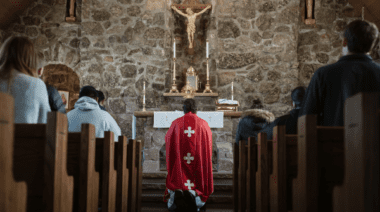
A: In my first post we laid the foundation of Church teaching on this topic. In this post, we will explore a bit more of the wisdom behind our Sunday privilege and obligation. Part II: God’s Time Management Tricks, or, Reasons behind the Third Commandment: Keeping the Lord’s Day Holy At some point, we have all complained about time. Usually we complain that we don’t have enough of it. Our lives are so fast-paced (so goes the complaint, either to others or to ourselves) that they’re almost out of control. We find ourselves frantically racing against the clock as often as not, and suffer the perennial torture of interior tension, stress, and pressure. Some also catch other time-related diseases: procrastination, boredom, addiction to certain sensual pleasures or wasteful pastimes (e.g. Web surfing), and the like. We all know that time is precious, but few of us are satisfied with how we manage it. God invented time, so no one knows its ins and outs better than he does. In the Third Commandment, he presents us with the divine secret for successful time management, and he presents it not as a recommendation, but as a command – he knows we need it. Before we look at how to fulfill this Commandment, however, ask yourself a question: Am I willing to trust God on this one? No matter how odd this Commandment may seem, no matter how inconvenient, no matter how counter-cultural or even distasteful, are you willing to take the risk of following it? If not, you may as well skip the rest of this post. Otherwise, read on. The Original Sabbath: What Spiders Don’t Know “Remember to keep holy the Lord’s Day” summarizes the divine directive for mastering your time. That implies: 1) that there is a Day that belongs to the Lord, and; 2) that what we do on that day should somehow be different than what we do on other days. Originally, the “Lord’s Day” (the Sabbath, the Jewish Saturday) corresponded to the seventh day of the week, and it makes its appearance at the very beginning of history. Genesis chapter 2 tells us: “Since on the seventh day God was finished with the work he had been doing, he rested on the seventh day… So God blessed the seventh day and made it holy, because on it he rested from all the work he had done in creation.” God worked for six days and rested on the seventh. Man was created in the image of God, so he should follow the same pattern. A simple explanation of the “Lord’s Day,” but also profound: weaved right into the fabric of human nature, right into the tapestry of the space-time continuum, is the rhythm of work and leisure. Leisure, rest from our labors, is a requirement of human nature. Leisure involves the cultivation of relationships, of family unity (this is especially emphasized by the Church), refreshing and playful activity, relaxation, enjoyment of beauty (natural and artistic) and friendship – such activities liken us to God, who “rested” on the seventh day, and distinguish us from the rest of creation, which keeps on “working” 24/7 (spiders don’t take Sunday’s off to go on a family picnic). The Lord’s Day “is a day of protest against the servitude of work and the worship of money” (Catechism of the Catholic Church, #2172). But the Israelites had another reason to set aside a day for the Lord. “You shall remember that you were a servant in the land of Egypt, and the Lord your God brought you out thence with mighty hand and outstretched arm; therefore the Lord your God commanded you to keep the Sabbath holy” (Deuteronomy 5:15). We owe our existence to God, and taking a day off from “making a living” is an appropriate way to acknowledge that. But we also owe him our salvation. If Christ had not come, we would still be stuck in our sins; we would have no hope for heaven, for reaching the fullness of our human vocation (i.e. to live in communion with God). He restored what our sin had destroyed, and he keeps restoring it, keeps administering his forgiveness. On the Lord’s Day, therefore, we not only enjoy the rejuvenating power of leisure, but we also come together as God’s people to give him thanks, rendering him, as is only right and fair, “outward, visible, public, and regular worship” (Catechism of the Catholic Church, #2176). Sunday’s “Work” When Jesus Christ rose from the dead he gave us yet another reason to “keep holy the Lord’s Day.” Since it was the first day of the week (the day after the Jewish Sabbath), it called to mind the day of Creation (the first day of history); since it marked his conquest of sin and death, it recalled the Exodus from Egypt; and since it was also the “eighth day” (the day after the seventh day, the last day of creation), it marked the beginning of his New Creation, which will culminate in the eternal Sabbath rest of the new heavens and the new earth at the end of time. Thus the Lord’s Day migrated from Saturday to Sunday. If we are seeking first God’s Kingdom and banking on him to lead us to the happiness we long for, we will show it by celebrating the Lord’s Day in a way that will please him. We will follow the Church’s precepts by our heartfelt attendance at the Celebration of the Eucharist with our local Catholic community (not squeezing it in on Saturday afternoon so that we can sleep till two on Sunday) and by refraining from our normal work duties, even if it means planning ahead and getting those nasty chores done on Friday and Saturday. We will link our leisure activities to our most important relationships – those of the family – and to our active love for God and neighbor, not mindlessly giving into the secular rhythm of leisure on Friday and Saturday nights (and recovery in front of the TV on Sunday). We will show that we are God’s children by living his day in a spirit of gratitude, charity, joy, and hope for the dawn of our eternal day of rest. How exactly we live it out will depend on our own creativity and initiative. The fact that we need to do it (for the health of our relationship with God and the health of our own souls) and that God commands us to do it is incontrovertible. Unavoidable circumstances often hinder us from living out the Lord’s Day as we would like to (the Church understands that, as does God). But just as often we don’t even make an effort. If we don’t, we have no right to complain about stress and anxiety (God will just say, “I told you so!”). God invented time, and we would be wise to follow his weekly rhythm if we want to make good use of the little bit of it that comprises our lifetime. Yours in Christ, Father John Bartunek, LC, ThD Is Sunday Mass still an obligation? Part I of II
A: Well, I’ll try. But first, a disclaimer. It is easy to misunderstand what people say. So the “someone from the diocese” may not have actually said that “it is never a mortal sin to miss Sunday’s Mass,” but they may have said something that was easily interpreted like that. So, since I wasn’t present and this may not be an exact quotation (or intention) of the person in question, I will simply try to reflect a bit on the Sunday obligation itself. Wait – one more disclaimer. We should remember that one of the great advantages of being a Catholic is that we can know when our pastor or priest (or even bishop) is wrong: all we have to do is refer to the Catechism and the teaching of the Magisterium. So, even if a diocesan representative did state something confusing, we don’t really have to get too upset by it (everyone can make mistakes); we just have to go back to our sources and stick to the truth ourselves. Part I: The Sunday Obligation First, let’s make very clear that attending Sunday Mass (on the Sunday or on the vigil) and Mass on Holy Days of Obligation is a primary responsibility of every Catholic. The Catechism Says… On the web page run by the United States Conference of Catholic Bishops, we can find the relevant numbers of the Catechism:
On that same web page, there is a report on the bishops’ Catechism committee that correlates extensively quotations from Pope John Paul II’s 1998 Apostolic Letter, Dies Domini, and various numbers from the Catechism. Reading through the correlation is a fantastic way to meditate on the reasons behind the Sunday obligation. Here is one of the paragraphs from Dies Domini that the bishops’ committee cites – it’s language is a bit technical, but still quite clear:
In the United States bishops’ own Adult Catechism, they emphasize the importance of Sunday Mass attendance: “God, through the Church, obliges us to make Sunday holy by participation in the Eucharist and by our being prayerfully reflective as far as possible.” (You can read the whole short chapter here.) “Do not judge, or you too will be judged…” (Matthew 7:1) Okay, so it’s pretty clear that the Sunday obligation is not optional, and that purposely snubbing God by skipping is indeed a grave sin. But remember, we are not called to judge our neighbors. We have to avoid falling into self-righteous Phariseeism in the face of Catholics who do not fulfill this responsibility. Instead of condemning them, we should reach out to them, help them to understand the many reasons behind this duty, and the many positive fruits that come from fulfilling it – which means we need to understand those reasons ourselves, and live Sunday well enough to begin experiencing some of those fruits. Common Sense and Pastoral Sensitivity John Paul II’s Apostolic Letter on this topic did address some challenges to living Sunday well that we face in post-modern times. This can cause some confusion. Basically, the issue has to do with working on Sundays. Our world no longer universally recognizes Sunday as the Lords’ Day. As a result, we Catholics, in order to keep our jobs, sometimes have to work on Sundays. Likewise, for those of us who do try to live the Lord’s Day well, some family and recreational activities that are perfectly in synch with the Sunday rest require other people to work – at restaurants or community swimming pools, for instance. How are we supposed to understand this apparent contradiction? This challenge was one reason the Second Vatican Council authorized the vigil Mass (Mass on Saturday evening) to fulfill the Sunday obligation. And if a Catholic simply cannot make any of the Sunday Masses, he can speak with his local pastor to receive a dispensation from this obligation, and to work out alternative solutions. As regards working on a day that is meant to be for rest, the Catechism blends common sense and pastoral sensitivity (#2187):
Having seen the reality and gravity of our duty as Catholics to participate in the Sunday liturgy and live the Lord’s Day meaningfully, we are ready to reflect a bit more deeply on the reasons why this is the case, which we will, in my next post. Yours in Christ, Father John Bartunek, LC, ThD |
|
|