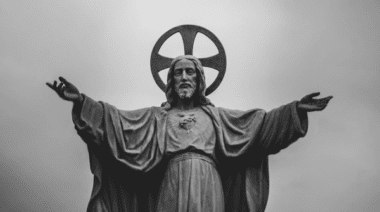
“If, then, you seek to know what path to follow, take Christ because he is the way.” - St. Thomas Aquinas
John 1:35-42: On the following day as John stood there again with two of his disciples, Jesus passed, and John stared hard at him and said, ‘Look, there is the lamb of God.’ Hearing this, the two disciples followed Jesus. Jesus turned round, saw them following and said, ‘What do you want?’ They answered, ‘Rabbi,’ – which means Teacher – ’where do you live?’ ‘Come and see’ he replied; so they went and saw where he lived, and stayed with him the rest of that day. It was about the tenth hour. One of these two who became followers of Jesus after hearing what John had said was Andrew, the brother of Simon Peter. Early next morning, Andrew met his brother and said to him, ‘We have found the Messiah’ – which means the Christ – and he took Simon to Jesus. Jesus looked hard at him and said, ‘You are Simon son of John; you are to be called Cephas’ – meaning Rock.
Christ the Lord In these few verses St John gives us three key titles of Christ, each of which should stir our hearts to gratitude, praise, and adoration.
First, John reemphasizes that Jesus is the “Lamb of God,” a title worth reflecting on again and again. The lamb appeared over and over in the Jewish scriptures and in their traditions. The central allusion, however, was to the Passover, when the Israelites sprinkled the blood of the Passover lamb on the lintels of their doors (cf. Exodus 12). The lamb had been sacrificed in order to save the Israelites, so that Moses would be able to lead them out of slavery. Christ was to be slain as well – on the cross of Calvary – and his blood was to be sprinkled on the lips of his faithful when they receive Holy Communion. In this way, Christians would be saved from the slavery of sin and led into the freedom of eternal life, the unquenchable abundance of heaven, by Jesus Christ, the Lamb of God. Christ is not only Lord; he is also Savior.
Second, Jesus is called “the Messiah,” or “the Anointed One” (the Greek word for this gives us the title “Christ”). This title referred to the promised successor to the throne of David, whom God had anointed king of his Chosen People. Under David’s kingship Israel had become a world power, reaching its peak of greatness and influence. God had promised that the line of David would never entirely fail, and he promised that a son of David would ascend to the throne to reinstate a new and even greater golden age for Israel. This Messiah (kings were “anointed” as a sign of their being chosen and strengthened by God for their divine mission on his behalf) would save Israel from all her sufferings and oppression, from all the misery that her sin had heaped upon her.
It is to save us, to rescue us from our own ignorance, weakness, and confusion that Jesus came. In relation to mankind, God’s glory consists in the human race reaching its full potential, in all people discovering the joy of a life lived in communion with God. Christ is the bearer of this glory, the King who comes to establish the sovereignty of God – with the peace and the fullness it entails – in every human heart.
Christ the Teacher Third, St John points out that the two disciples called Jesus “Rabbi,” which means “teacher” or “master.” Rabbis were popular Jewish leaders, not by position or birth, but by their knowledge of the things of God and their ability to teach and pass on that knowledge. In Matthew 19 and John 13, Christ makes an explicit and exclusive claim to this title, affirming that he is the definitive teacher of the things of God and demanding the absolute allegiance of his followers.
Even in this passage, we detect the unprecedented authority Jesus claims when he renames Simon. In the Jewish scriptural tradition, only God gave new names to people, and he only did so when he gave them a prominent role in his plan of salvation and connected them in a special way to his covenantal promise. Christ’s exercise of such authority during his first meeting with Simon certainly would have given these disciples a hint that this Galilean was no average rabbi. (It also is one of the many indications in the gospels that the preeminent role of Peter, and thus of the Papacy, was instituted and intended by Christ himself, and not merely an invention of the early Church.) Christ is Lord and Savior, but he is also the Master, a Teacher unlike any other. To follow him and learn from him should be our greatest joy.
Although Christ’s titles bespeak his greatness, his behavior in this first encounter with John and Andrew shows his simplicity and humility. He walks by the place where they and John the Baptist are baptizing. He simply walks by. He makes no grand entrance, employs no intimidating tactics. When John and Andrew finally decide to go after him, he turns around to welcome them. He makes no demands, gives no orders, and passes no judgment. Rather, he engages them in a conversation and issues an invitation to come and spend time with him. This is how Jesus works. This is how he calls us, gently, unexpectedly, personally. The era of flashing fire on the mountaintop is over; the era of good-hearted friendship and intimate companionship with the eternal God has begun.
Christ the Friend This is Jesus’ first encounter with his first disciples. It is the beginning of the second half of human history – an important occasion. Surely the evangelist is describing every detail with care, most especially the very first words that Jesus speaks in this Gospel. He asks his future Apostles a simple question: “What do you want?” (What do you seek? What are you hoping for?) It is still one of Christ’s favorite questions. Jesus already knows the deepest desires of every heart, but many people never take the time to reflect on their own deepest desires. Jesus poses the question in order to spur that kind of reflection. Unless we take time to examine ourselves and our lives, we can easily end up looking for meaning and happiness in the wrong places, mindlessly latching onto every passing fancy and popular guru, bouncing from fashion to fad, never drinking of the living water that only he can give.
Jesus: My first two disciples gave the right answer to this question. They asked where I was staying. What did they want? They only wanted to come and stay with me. That is how you answered the question too. How it pleases me to find humble, thirsting hearts – what a feast I have in store for them! What do you want? What are you seeking? If you want the right thing, everything else will fall into place. If you don’t, nothing you do will give rest to your soul.
Christ in My Life Where do you live, Lord? I want to find you and stay with you. You are the creator of the mountains, the ocean, the clouds, and the stars. You are the wisdom that gives order to the universe. You are the spark of light that gives man a knowing mind and a loving heart. You are the source and goal of all things. And you have come to live in my heart. You are mine, and I am yours. Let me stay with you…
I need a Teacher, Lord, and I choose to sit at your feet and listen to you. Sometimes I find myself yearning so much to understand things – to have true wisdom – that I am almost in pain. You made me with a need for truth. You are the Truth. Speak to my heart, Lord. Send your Spirit to teach and guide me. Never take your eyes off of me…
What do I want? I want so many things! I want happiness, Lord. I want happiness for myself and for those around me. Fulfillment, meaning, satisfaction. I want my life to bear the fruit you created it to bear. I want to look into your eyes and see you smile on the day you call me home to eternity, and I want to hear you say, “Well done, good and faithful servant…”
PS: This is just one of 303 units of Fr. John’s fantastic book The Better Part. To learn more about The Better Part or to purchase in print, Kindle or iPhone editions, click here. Also, please help us get these resources to people who do not have the funds or ability to acquire them by clicking here.